Then Krishna took another leaf, tore it, and threw the two pieces into opposite directions. When the next fight began Bhima again tore Jarasandha in to two halves, but this time, he threw the two halves in opposite directions.
In my first attempt to connect chess to freestyle wrestling I have defined a space of 64 cubes and devised rules how chess pieces navigate that space. The resulting system was only partially good. I liked the way I could explain mate on f7 in wrestling terms. But the details of the system I designed were only partially intuitive and corresponded to wrestling. I wanted to explain each chess move from the logic of wrestling. My goal was to connect chess geometry to wrestling geometry.
I didn’t like the way it was designed that e2 pawn, which is a forfoot in the correspondence where pawns are leg joints, moved to e3, which is fixed for king, because the 3rd rank is fixed for pieces, moved up to a cube which is at the height level of a belly. Nobody moves up feet so high in wrestling. Only soldiers do that when marching on a parade. Even worse is when d2 pawn went to d3, it went up to the height level of the neck. Although the resulting system is completely isomorphic to chess and one can move cubes in space by corresponding chess moves and the resulting game will be just chess, it is a weird one. So what’s next? And how to design the space so that it is completely isomorphic to wrestling?
Firstly it is impossible to create such isomorphism without changing some chess rules. For example in chess pawns could only move forward. That is good. Moreover if a game of chess is just one wrestling attack as it was explained in my first blog, a successful attack in wrestling almost never allowed that an attacker takes back steps. But the defendant will do many backsteps in real life wrestling match. He will sprawl his legs to defend from the leg shot. Take few steps back to get out of the uncomfortable grip and etc. Perhaps in ancient wrestling the stepping back was not allowed. That’s also possible.
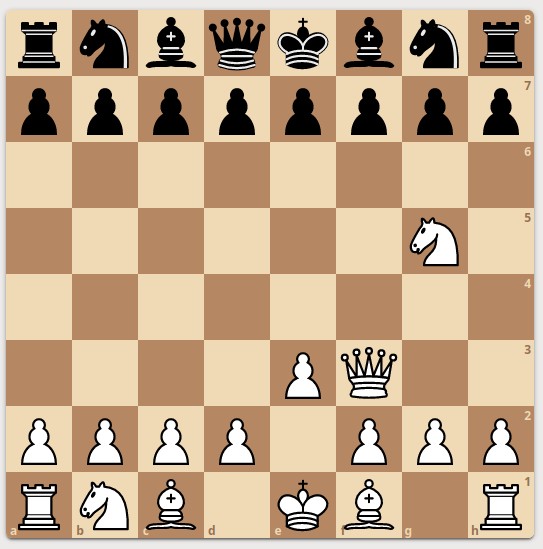
F7 mate is a low head single
The way to fill the void is to create more examples of chess wrestling correspondence. As it was explained in the first blog mate on f7 corresponds to low single leg attack. F7 pawn is black’s ankle joint. When you make a low jump with one of your forefeet, keep your head low, attach the neck to opponents ankle, grab his ankle with your arm or elbow from behind and start pressing with your neck and part of the head into ankle and slightly above you will start create danger for opponents center of gravity, and he will lose his balance and will fall on his butt.
That’s checkmate as it was explained that’s check in wrestling is state of stable or unstable equilibrium where opponent center of mass becomes vulnerable and if it results that center of mass hits the ground, that’s checkmate. But if the equilibrium is stable and the opponent gets back control of his center of gravity, he is again stable, he was just checked. So you can do low head single using your neck and either palm or elbow. F7 mate is made with queen, neck, and either knight, palm, or a bishop, elbow.
Fireman’s carry
This move is an attack on opponents right or left shoulder, rooks, and right or left hips, A or H pawns, depending on which side of the attack is chosen. Say the attack is on opponents right shoulder. Attacker also uses his neck, queen, left palm, knight, and his right shoulder, rook, right elbow, bishop, and palm, knight, as well as his king and some queen side pawns to make this throw. Even the white’s waist is involved in some variations.
Right and left in chess, Bhima fights Jarasandha
As it was explained in Indian epic Mahabharat Episode 29: When Bhima Wrestled Jarasandha. The right and left side of the body played crucial role in Bhima’s win. Bhima first tore Jarasandha in to two halves right and left as Krishna showed him by tearing the leaf into 2 halves. But when he threw right half to the right and left part to the left Jarasandha body was stitched back and he survived. Then Krishna took another leaf, tore it, and threw the two pieces into opposite directions. When the next fight began Bhima again tore Jarasandha in to two halves, but this time, he threw the two halves in opposite directions. Nothing happened. Jarasandha was finally dead.
So figuring out if white king side pawns are white’s right leg while black queen side pawns is also black right leg, as it should be when two wrestlers are standing in front of each other face to face is difficult. Perhaps king side pawns for both wrestlers are right side legs. It is difficult to resolve. But it is important for fireman’s carry explanation.
In wrestling, the fireman’s carry is a dynamic throw that attacks the opponent’s shoulder and hip simultaneously. Translating this into chess, the move maps onto a complex and coordinated assault across the board, one that blends power, positioning, and leverage. The right-side attack, though happening on the queen side of the board for Black, aligns with the right side of their body, because wrestlers face each other directly and their right and left are mirrored.
The move starts with White’s queen-side knight jumping to attack the a7 pawn. At the same time, the queen ducks under the opponent’s arm, lining up behind the rook at a8, just like tucking your head under their armpit in a real fireman’s carry. From there, the attack builds momentum. The b7 pawn may instinctively step forward and the line opens for the queen to capture the rook at a8. The body then sinks under the opponent’s center of gravity. The thrower is now sitting beneath their opponent, with the enemy’s upper body draped across their neck and shoulders.
To complete the throw, White uses further leverage from the left arm, the right elbow, and the forearm, all reaching into the opponent’s lower limbs. This final coordinated surge is what sends the defender airborne and flips them onto their back. It is a beautiful sequence where chess geometry maps onto a real-world wrestling throw.
Is Chess an Abstract Replay of the Body?
At some point, I began to wonder whether chess wasn’t just a metaphor for wrestling, but that chess itself is an ancient abstraction of human body conflict. That it encodes, in symbolic and geometric logic, the mechanics of balance, leverage, pressure, and counter-moves, everything that happens in a match, but expressed not through the muscles of the body, but through the movement of symbols.
Maybe that’s why both wrestling and chess are described as wars. Maybe that’s why both start from a stance, a mirrored, balanced position. And maybe that’s why they both end the same way: when one player, or one body, is out of moves.
Arm Throw
An arm throw is perhaps one of the most iconic moves in freestyle wrestling. It is often quick, explosive, and beautifully executed when timed well. To map it into a chess-based geometry of joints and pieces, I needed a correspondence that included rotational movement, upper body control, and diagonal leverage, which naturally brings bishops and knights into the picture again.
An arm throw starts by isolating an arm, typically by gripping the opponent’s wrist, elbow, or shoulder, depending on entry. Then the attacker performs a rotation using their own waist and neck to create a pivot point. You could say that in chess terms, the queen and king create the axis, and the throw occurs when surrounding pieces create pressure on an isolated square or joint.
Sacrifice in Chess is giving up a limb in wrestling
Sacrifices in chess are often misunderstood by beginners as a blunder. But seasoned players know they’re a tactical device to change geometry, to open a diagonal, to expose the king, or to remove a key defender.
I remember one instance when my brother Sanasar wrestled with Peter Naniev in the Soviet Championships semifinals in 1984. With 10 seconds left the score was 4-4 and Sanasar was losing by decision if he did not score. So he went forward with his head down and allowed Peter to capture his head, a queen sacrifice. Peter grabbed Sanasar's head. But Sanasar performed a high crotch and scored and won that match.
High Crotch
If the low single is a clean, straight-line attack at the ankle, f7 mate, then the high crotch is its cousin: a deeper penetration shot that targets the inner thigh or upper hamstring, close to the opponent’s center of mass. It’s a move where you don’t just grab the leg, you go through it, often with your own torso pressed into the opponent’s hip, your head up, your spine aligned, and your back leg ready to drive forward like a piston.
In chess terms, this corresponds to an attack not on f7, but deeper, on d6 or e6, the thighs and hips of the defending body. In my model, the pawns are joints of the legs: ankle, knee, hip, and so on. So a pawn on e6 or d6 is not just a leg, it's the thigh or hip joint of the defending wrestler.
A successful high crotch in chess, then, would be a move where a knight or queen penetrates into e6 or d6, from a central file like e4 or d4, supported by a pawn drive or piece combination that opens the center. The white queen comes into e6, the white knight is supporting or following into f5 or d5, and the white pawn from d4 or e4 represents the driving leg of the attacker.
Closing Reflection
If low singles are about sneaking under the opponent’s balance, high crotches are about penetrating into it, entering the torso space, disrupting from within. On the board, this means going beyond pawn structure and challenging the internal geometry of the position. It’s no longer just about grabbing a piece. It’s about tilting the axis of the game.
That’s the language I’m searching for. A way to feel wrestling through the syntax of chess.