Introduction
Few years ago in the pandemic I was stuck at home with more free time at hands, so I signed up for EDX CS50 course to study artificial intelligence in Python and JavaScript and I wanted to apply the knowledge to some game imitating free style wrestling. I’ve chosen three paths to this AI problem: on one path I compared wrestling to a maze, on another path I compared wrestling to a game of tic-tac-toe and the third path was set to compare wrestling to chess. The first 2 paths led me nowhere. But the third was some success. It took much longer then the cs50 course, and in this article I want to present some results.
I have been wrestling since I was 10, and still do at 54. Many chess players can say the same about their chess biography, but not too many wrestlers stayed on the mat for that long. I come from big wrestling family and with some chess connections. Both of my older brothers wrestled and my oldest brother Sanasar Oganisian won Olympic gold in 1980 in free style wrestling and numerous world and Soviet titles. The older brothers took chess lessons from my uncle Artashes Oganisian, who fulfilled the criteria for Chess Master in the Soviet Union in the 70ies, although he could not confirm it as rules required due to very poor health and remained a candidate master.
His youth friends included Yerevan grand masters Rafael Vaganian and others, perhaps they know more about Artashes ability then I remember. Around 15 years old Artashes did tie with Tigran Vartanovich Petrosian in a simul given by Petrosian in Yerevan when he visited Yerevan after wining world title in 1963. And there is a newspaper article highlighting that in family archives. Artash also had a passion for yoga and overall India and spoke about history of chess. So chess was very popular in my family although wrestling was a key passion.
My dad taught chess my kids and then they met a brilliant chess coach in their school. They started winning some tournaments, but I was quite skeptical and discouraging about their chess carriers waiting when they will pick up a passion for wrestling which they also practiced.
With kids I maintained the line that chess is great fun, which they can stay with their whole lives, but there is no need to devote countless hours of practice to chess when they can be outside playing. Still the kids got me involved in chess a little. We frequently went to Moscow chess club on Gogol Boulevard to play blitz and at some point they introduced me to Lichess.

This was around the time when I set the goal to find some connection between wrestling and chess and took the JavaScript course to find some results.
While spending countless hours on lichess I was brainstorming for a wrestling chess connection, playing again and again. So I found some connections and wrote some code to implement it.
I Will Explain It Later In Detail
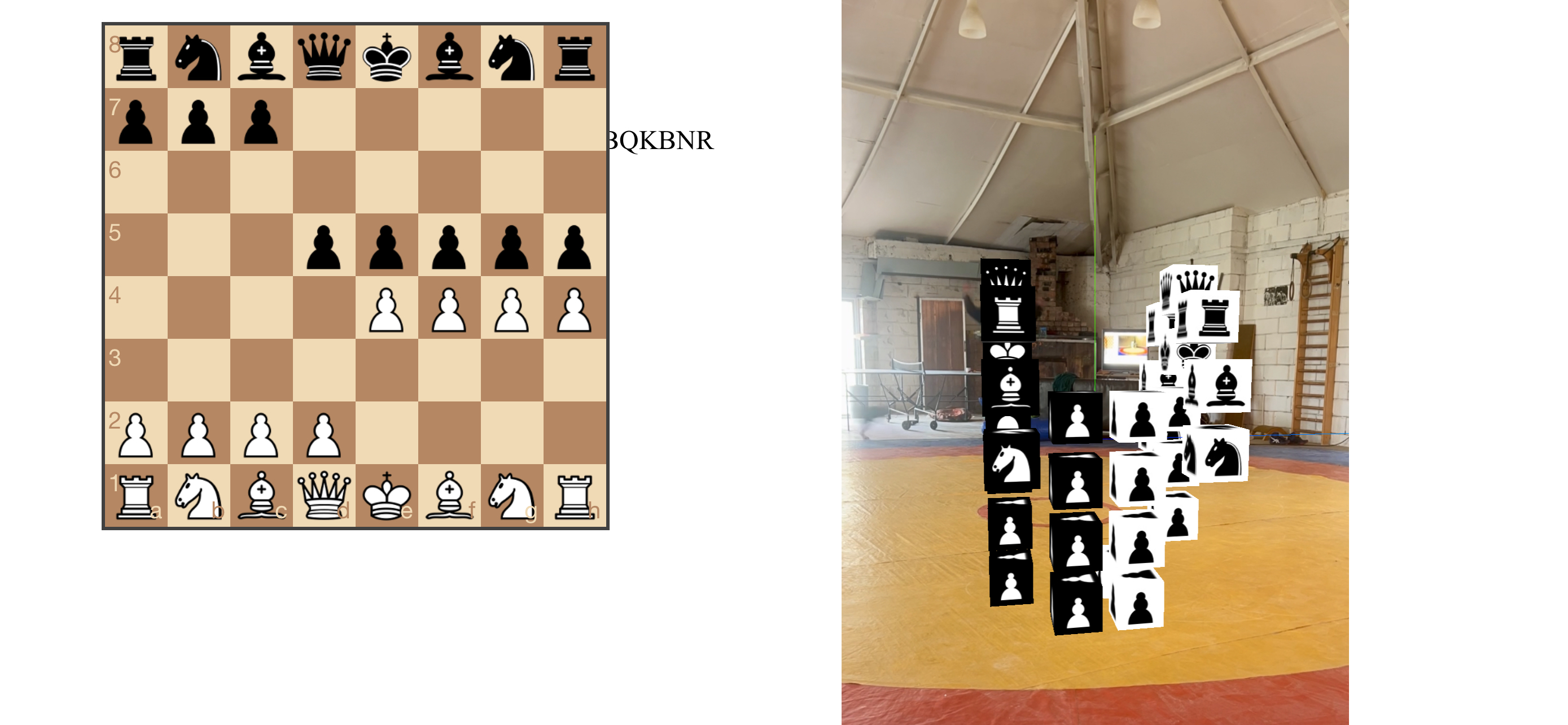
I defined 64 cubes in space by drawing 4 imaginary wrestlers each consisting of 16 cubes which were fixed and there was a strict rule which mapped the cubes to chess squares and which described each of 64 cubes.
For example an A1 square is fixed for white rook, so is A3. A2 square is fixed for white pawn so is a4. A8 and A6 are fixed for black rook and A7 and A5 cubes are fixed for black pawn. If for example a white figure moves in to the space of an black wrestler crossing the 4th rank it should navigate his space in a manner where cubes were defined for black.
- Hands are heavy pieces, play for white and black does random moves
- Hands are heavy pieces, play for white and for black
- Hands are pawns and legs are heavy pieces, play for white and for black
- Hands are pawns and legs are heavy pieces, play for white and black goes random
Freestyle Wrestling And Chess Have A Lot In Common
Freestyle wrestling and its US version collegiate wrestling are direct descendants of Indian Kushti wrestling or Pehlwani and Persian version Pahlevani wrestling. This is where similarities begin, as chess has both Indian and Persian roots.
An attack in wrestling is initiated with bringing up your arms extending palms, and engaging feet, elbows and knees, controlling opponents neck, shoulders and legs, creating a solid stance and then trying to penetrate inside opponent’s joints to find weaknesses, inaccuracies and waiting for opponents mistakes and blunders. An attack can end in score, or touché it could also lead to steal mate or can cause a counterattack if the opponents’ defense is strong.
Wrestling Attacks And Moves Can Be Abstractly Represented By Chess Pieces Moves On The Chess Board

I start this research project with the most obvious similarity between chess and wrestling. Wrestling deals with joints of the body. Chess deals with pieces. However I found out that there is a correspondence or a map between chess pieces and human body joints and what is most stunning that the symmetry of the human body is preserved when this map is applied to joints of the human body and corresponding chess pieces.
Correspondence Of Chess Pieces And Joints

The figure above shows one example of such correspondence where pawns are hands and heavier pieces are legs, neck and waist. There is another arrangement possible where hands are the heavier pieces and pawns are legs. I will consider it later in the study.
Human body has 18 key joints which are used when a human dances, wrestles or is playing twister. In the two arrangements I described above I only use 16 joints. In the first where hands are the pawns I assume that foot finger and an ankle is just one joint while palm and wrist are 2 separate joints. In the second arrangement where pawns are legs in reciprocity I assume that foot fingers and ankle are 2 separate joints while palm and wrist is just one joint. Both approximations are valid in my view.
4 right pawns are mapped to 4 joints of a right arm, 4 left pawns are mapped to 4 joints of a left arm and more expensive pieces rook, knight and bishop right and left are mapped to leg joints of right and left legs while king is mapped to waist joint and queen is mapped to neck joint. Notice that symmetry of joints is preserved.

Wrestling Space
I have used three.js javascript library popular for 3d animations and chessboard.js and chess.js libraries to write code that connects chess moves and human joint moves.

There are several versions of 3d chess: one is famous Kubikschach which uses 8x8x8 cube for chess space and there is a version with 5x5x5 chess space called Raumschach. There is also Star track chess which uses 64 squares arranged in 3d space. Our versions of chess wrestling space also uses 64 cubes. Using the naive approach I organized 3d chess wrestling space into 4 sets of 16 cubes arranged in 3d space.
Each set of 16 cubes is a wrestler shown in the figure below. It is an abstract schematic representation of a wrestler which only shows the body joints. In the middle there is neck and waist or head and back doesn’t really matter how you call it. On the right and left sides there are arms and beneath are legs.
There are 4 such imaginary wrestlers in our space. 2 stand in the initial positions representing chess figures on first and second ranks for white and on the 8th and 7th ranks for black. And they are visible when game starts. The other 2 wrestlers are placed between the first two by translation.
Moves In Chess Wrestling
The 64 cubes I defined by drawing 4 imaginary wrestlers in space each consisting of 16 cubes are fixed and there is a strict rule which maps the cubes to chess squares and which describes each of 64 cubes.
For example an A1 square is fixed for white rook, so is A3. A2 square is fixed for white pawn so is a4. A8 and A6 are fixed for black rook and A7 and A5 cubes are fixed for black pawn. If for example a white figure moves in to the space of an black wrestler crossing the 4th rank it should navigate his space in a manner where cubes were defined for black.
Say for example a2 white pawn goes to a3 then to a4 then to a5 and then goes to a6. If a2 pawn is a shoulder, as in the arrangement when pawns are hands, the same piece starts being read through a different body location as it crosses the translated wrestlers.
This arrangement abstractly resembles wrestling. In the beginning of the wrestling match two wrestlers are separated by roughly 2 steps. Each can make roughly one step forward without encountering opponent’s body parts. If you make another step forward most likely will be penetrating into the other wrestler space.
Mate On f7
By moving pawns and pieces you can try to extend arms and make steps with legs and etc. But one immediate study I want to perform is how mate of F7 corresponds to a lethal attack in wrestling.
I initially arranged wrestlers such that pawns were being arm joints and heavier pieces were leg joints. In that arrangement I found that mate on F7 is difficult to describe in wrestling terms. However if you arrange a wrestler where legs are pawns and arm joints are heavier pieces the mate on f7 makes perfect sense. In wrestling it is called John Smith’s low head single shot.
You can watch John Smith explaining this shot on youtube: video link.
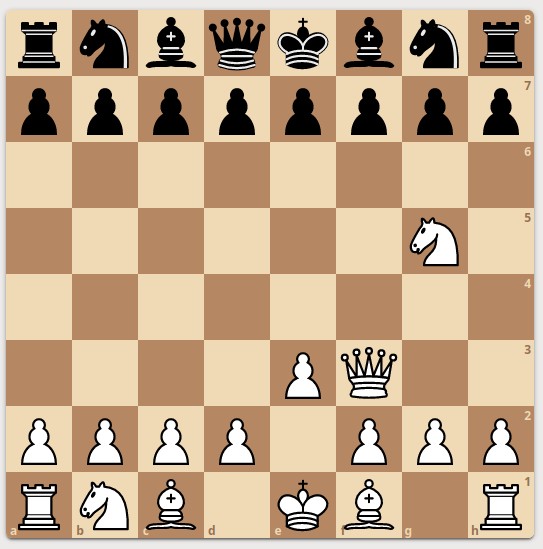
Coming back to the first arrangement where hands are the pawns and legs are pieces, and if I define f7 and c7 pawns as shoulders and not the wrists, it is sort of possible to connect f7 mate to a wrestling attack. It is called a wizard in freestyle wrestling or uchi mata in judo.

Legs Are Pawns And Hands Are Heavier Pieces
I was trying to look at various abstract possibilities for mapping chess pieces and body joints and the relation where legs are pawns and hands are heavier pieces makes more sense than other maps but the map is still a much open question. The 64 space cubes arrangement is also an open topic.
What’s A Check In Wrestling?
For a man to become unstable and lose ground and fall he or she must be in a state of unstable equilibrium. This is when your center of gravity loses support. From the F7 mate example there was no direct attack on the king, the waist, but the black wrestler lost control of its center of gravity and had to fall on his butt.
So it is possible to map a check in chess to a state of the unstable equilibrium of a wrestler where he will lose control of his center of gravity or he will give up control of his center of gravity to another wrestler.
The Mate
The mate in wrestling is touché. It is when you are laying on your back, your opponent has complete control of your back. This is when you are pinned. Your back can’t move. There are no moves left for your back. Opponent’s hands are holding your arms, your neck or your knees or thighs. Your center of gravity is completely made incapable of moving by your opponent joints.
The Similarities So Far
So far I observed the correspondence between chess pieces and body joints. I also noted that the beginning of the wrestling match and chess game is similar. The strategic goals in wrestling and chess are also similar and involve penetration into opponents’ quarters. The goal of a chess game and the goal of wrestling match are also identical and it is to pin the opponent or to checkmate the opponent.
Further Similarities
Exploring further similarities I posit that one chess game is just a very slow version of one wrestling attack. And similarly a wrestling match is number of chess games played between opponents. Some of these games are very short and end in tie. For example in a match two wrestlers make few steps cross their arms and make few grips and then unable to find weakness return to their initial position.
Evaluating Stability Of Center Of Gravity Of Chess Positions
Using the tools developed here it is possible to evaluate center of mass and the center of gravity of abstract white wrestler and black wrestler and see how far from the equilibrium they are. This is an idea of evaluating position by geometric and mechanical measures.
Promotion Of Pawns
The algorithm that I described for chess wrestling board stipulates that all 64 cubes arranged in space are mapped to very specific black or white chess pieces or body joints. So if a white pawn travels to the 8th rank it will become a piece or will stand on a field which mapped to the particular piece.
The Chess Board, The Wrestling Mat, The Akhara
Kushti is very tightly attached to Indian religion. Akhara in northern Indian villages is a place where wrestling is practiced, learned and taught. It consist of a several mandatory items like water well, some shrines but the central item of the Akhara is wrestling pit. Wrestling Akharas are as old as India itself.
Here Is One Possible Way That Chess Was Invented
Sarabjit Pahalwan was a great wrestler. He was a very devout believer in Hanuman. But one day he fought with a lion in the jungle and the lion bit off his right leg and Sarabjit Pahalwan although he was able to survive could no longer wrestle. This worried and saddened him.
Ananta was a sannyasi, a religious guru in Sarabjit’s village, he was a great theoretician of wrestling and a great mathematician as well. Seeing Sarabjit sadness he started to think of an imaginary wrestling system. After 5 years of hard work he finally came up with chaturanga rules and taught it Sarabjit Pahalwan who then became a very skilled chess player and maintained his chess Pahalwan status until his death.
Over the years the original connection of chess and wrestling was lost. But could possibly been reinvented recently.